 An official website of the United States government


Many different strategies, models, methods, and technologies are used in biomedical research. The specificity of the individual research question dictates what approaches are appropriate. In other words, different research questions necessitate the use of different approaches. Some approaches involve animal models, some others do not. While animal models continue to be important to advancing scientific knowledge across many fields of biomedical research, NIH encourages researchers to use alternative and complementary approaches to ensure rigorous and reproducible studies whenever possible and consistent with the scientific aims of the project.
NIH-funded researchers have used alternative methods extensively for scientific and medical discovery, and they continue to hold great promise for the future. As alternative methods continue to become increasingly sophisticated, the prospect of refining, reducing, and replacing the use of animal models in research (also referred to as the 3Rs) becomes more feasible. Accordingly, NIH continues to invest into identifying and developing appropriate biological systems, including human-based methods, to maximize research translation.
Advancing alternative testing models is a priority of the NIH Director, and in April 2025, NIH announced a new human-based science initiative (HBSI) to expand innovative, human-based science while reducing animal use in research. Since the announcement, NIH has driven this work forward by:
- Announcing that NIH will no longer issue new funding opportunities focused exclusively on animal models of human disease. Rather, going forward, new funding opportunities will be designed more broadly with language that encourages the use of innovative, human-based approaches, and may exclude animal use. This means researchers may choose any model they deem appropriate – including a combination of approaches – to answer a research question when submitting applications seeking NIH support (see more here)
- Expanding its existing work in this area, including:
- Work by the Common Fund Complement Animal Research In Experimentation (Complement-ARIE) program to develop and integrate NAMs in research.
- NIH-led federal collaborations to reduce, replace, and refine animal use for toxicology testing through the Interagency Coordinating Committee for the Validation of Alternative Methods (ICCVAM) across 18 federal agencies.
- Advances funded across NIH such as the NCATS Tissue Chip program to bioengineer “organs on a chip” that mimic human organ function.
- Awarding contracts for new efforts on alternative models:
- The Standardized Organoid Modeling (SOM) Center, a new national infrastructure resource created to address a pressing challenge in biomedical innovation: making organoid technologies reproducible, scalable, and trusted for clinical and regulatory use.
- The Collection of Alternative Methods for Regulatory Application (CAMeRA) database, which will serve as a new interactive, searchable web database of validated and qualified alternative methods.
This work builds on NIH’s convening of an outside group of experts in 2022 to identify high priority areas and catalyze the use of Novel Alternative Methods to Advance Biomedical Research. This group released a report with recommendations the following year, which was endorsed by the Advisory Committee to the Director, sent forward for approval by the NIH (PDF), and accepted by the NIH Director in February 2024.
It also aligns with efforts to advance alternatives, including a parallel initiative by the U.S. Food and Drug Administration to reduce animal testing in the development of monoclonal antibody therapies and other drugs.
Some examples of specific scientific efforts to replace animal models in NIH-funded studies include:
- Testing cells and tissues in test tubes or cell cultures
- 3D tissue culture, also referred to as organs-on-a-chip
- Computational and mathematical models, such as for toxicity testing
- Stem cell research
- Non-invasive diagnostic imaging
- Clinical research involving people
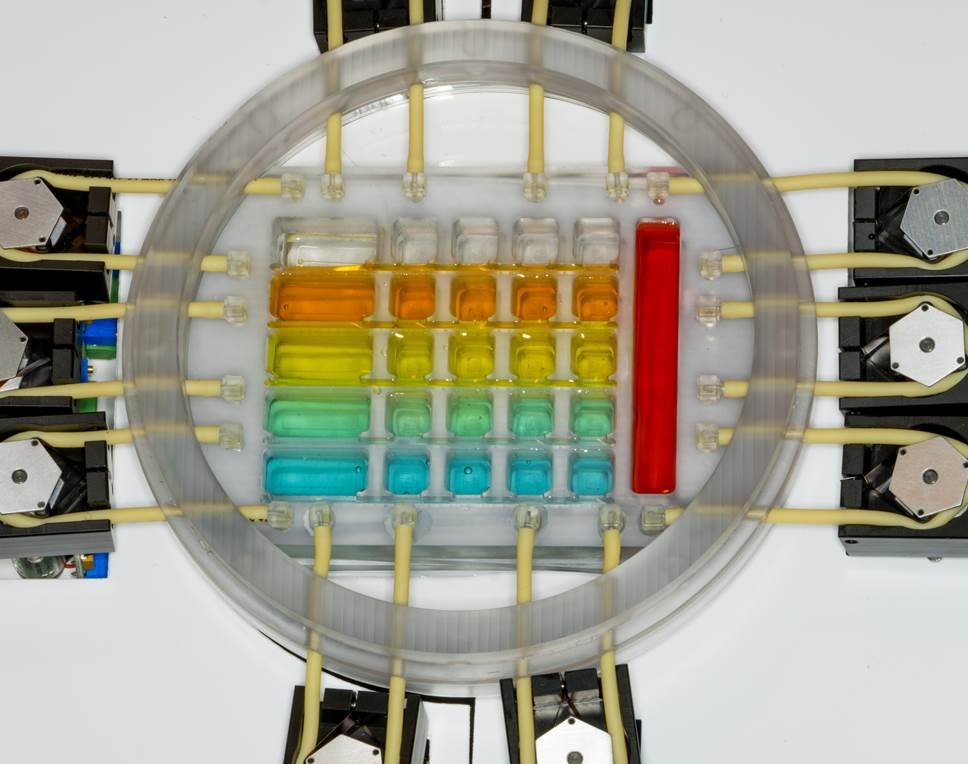
Image from https://ncats.nih.gov
NIH also provides training and other resources for scientists to assist them in identifying and/or developing non-animal alternative approaches as well as training on ensuring the welfare of animals used in research when there is no other suitable alternative. Many of these resources are focused on the 3Rs. The resources below are helpful to learn more about the 3Rs, including alternatives to the use of live animals:
- A yearly, NIH co-sponsored symposium with presentations from international experts on the latest advances in the 3Rs, effective use of animal models, scientific rigor and animal welfare. Recordings of past session are available on the US Department of Agriculture page under the “Annual 3Rs Symposium.”
- Nine U.S. Government Principles, adopted in 1985, are the foundation for humane care and use of animals in biomedical research in this country. Of particular interest is the third principle that requires the minimum number of animals to be used as scientifically necessary and animal models to be replaced with non-animal models wherever possible. Principle IV meets the 3Rs requirement as well by requiring researchers to avoid or minimize discomfort, distress, and pain in animals consistent with sound scientific practices.
Though advances in alternative approaches are being made every day, research with animals continues to be essential for understanding human diseases, biological processes, and developing treatments. Alternative approaches cannot completely replace the use of animals at this time. The alternatives simply cannot yet accurately replicate or model all the biologic and behavioral aspects of human disease.
Until that time, animal models will remain integral for live-saving NIH-supported research. However, NIH and NIH funded scientists are continually working to replace, reduce, and refine animal use and improve the welfare for animals that are essential for scientific progress.