 An official website of the United States government


The Domestic Assurance is required for U.S. institutions that conduct live, vertebrate animal work onsite for PHS, NSF, or NASA-funded or supported animal activities.
Domestic Assurance
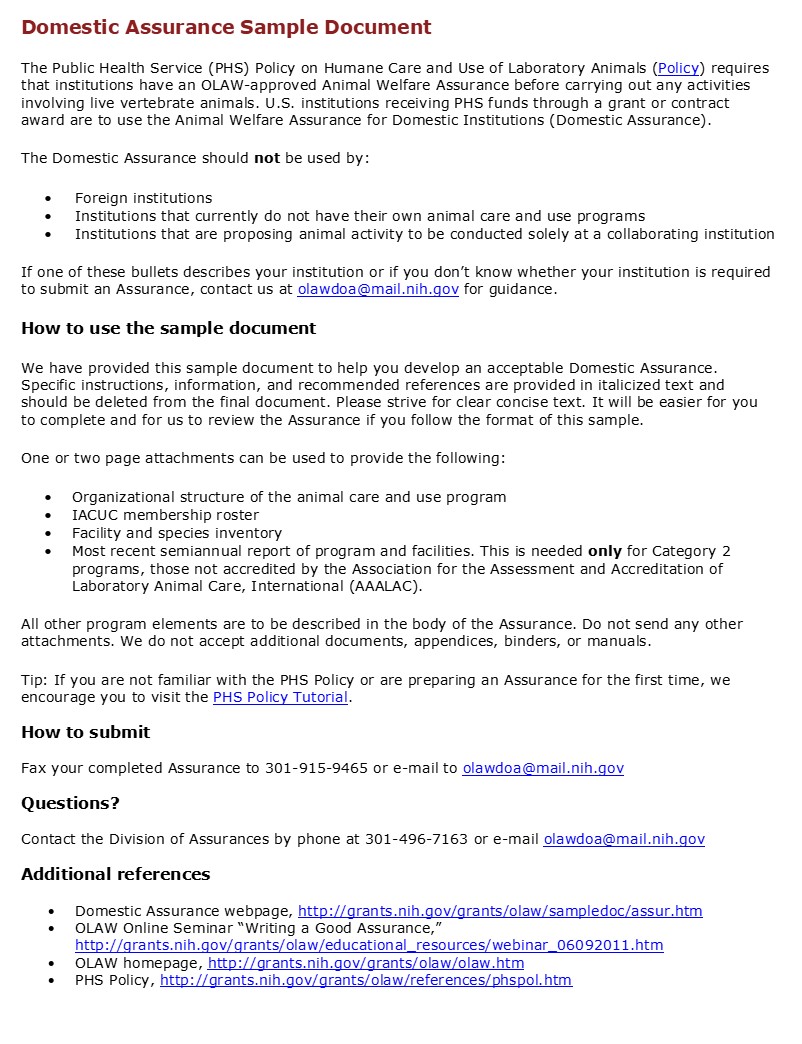
A Domestic Assurance is required for U.S. institutions that control their own animal facilities, conduct animal research onsite, and have an animal care and use program in compliance with the PHS Policy and the Guide. Domestic Assurances are approved for a period of up to 4 years and will be renewed only if the institution continues to conduct live, vertebrate animal work onsite for PHS, NSF, or NASA-funded or supported animal activities.
PHS components include the National Institutes of Health (NIH), Centers for Disease Control and Prevention (CDC), Food and Drug Administration (FDA), and Biomedical Advanced Research and Development Authority (BARDA)
The Domestic Assurance form is not to be used by foreign institutions, institutions that do not have their own animal care and use program, or institutions proposing to conduct an animal activity solely at one or more secondary institutions.
Basic Elements of the Assurance
The following are the basic tenets that should be addressed in every Assurance. The Assurance form provides prompts for each of these areas.
- Facilities and components of the institution that will be covered by the Assurance
- Institutional commitment to the Animal Welfare Act, the U.S. Government Principles and the Guide for the Care and Use of Laboratory Animals
- Description of program for animal care and use
- Program evaluation and accreditation
- Recordkeeping
- Reporting to OLAW
- Institutional endorsement
- Membership of the IACUC
- Facility and species inventory
Writing Your Assurance Document
Institutions that meet the criteria for a Domestic Assurance must download and use the Domestic Assurance form. Specific instructions, information, and recommended references are provided in the italicized text and should be deleted from the final document. Submissions should be clear and concise, utilize the section headings, and retain the numbering and format included on the form. One or two page attachments can be used to provide the following:
- Organizational structure for the animal care and use program
- IACUC membership roster
- Facility and Species inventory
Category 1 institutions (those that are accredited by AAALAC International) may incorporate portions of the AAALAC Program Description (AAALAC PD) in applicable parts of the Domestic Assurance document. More information on how to incorporate AAALAC PD information into the Assurance is provided in a separate section below.
Category 2 institutions (those not accredited by AAALAC International) must provide the most recent Semiannual Report to the IO along with the completed Assurance. The Semiannual Report to the IO may be provided as a separate file and should include all PHS Policy-required components as described in PHS Policy IV.B.3.c-e and Section III.D.3. of the Assurance document. OLAW highly recommends the use of the sample document Semiannual Report to the IO.
Tips to Facilitate Review
Here are some helpful tips to help speed up the review process. However, this list is not intended to provide an exhaustive overview of all possible revision requests; as every institution is unique, always follow the guidance of your Assurance reviewer.
Tip 02: Review the PHS Policy and OLAW FAQs While Drafting Your Assurance
Tip 03: Account for Everyone
Tip 04: Ensure that the Assurance Reflects Your Unique Program
Tip 05: Completely But Succinctly Describe Your Program
Tip 06: Update the IACUC Roster, Key Contacts, and Facility Inventory
Tip 07: Respond Promptly
Using AAALAC Program Description Sections in the OLAW Domestic Assurance
The AAALAC PD may be incorporated into specific areas of the Assurance form:
Assurance Part III.D.9
Assurance section: "III.D.9 Describe how the IACUC monitors ongoing activities (post-approval monitoring)"
May incorporate: AAALAC PD Section "2.I.B.2. Post-Approval Monitoring"
- a. Describe mechanisms for the Institutional Animal Care and Use Committee (IACUC) review of ongoing studies and periodic proposal/protocol reviews (PD pg. 18)
- e. Describe any other monitoring mechanisms or procedures used to facilitate ongoing protocol assessment and compliance, if applicable (PD pg. 19).
Assurance Part III.E
Assurance section: "III.E The risk-based occupational health and safety program for personnel working in laboratory animal facilities and personnel who have frequent contact with animals is as follows: [Describe the Institution’s occupational health and safety program for personnel involved in the care and use of animals.]"
May incorporate: AAALAC PD Section "2.I.A.2.b. Occupational Health and Safety of Personnel"
- i.1) List the institutional entities that are involved in the planning, oversight, and operation of the institutional occupational health and safety program related to animal care and use (PD pg. 6).
- ii.1) a) Describe who receives personal medical evaluation as a component of individual risk assessment (PD pg. 8).
- ii.1) d) Describe safety considerations for individuals with incidental exposure to animal care and use (e.g., contractors; PD pg. 8).
- ii.1) e) Describe general features of the medical evaluation and preventive medicine programs within the context of work duties including: pre-employment/pre-assignment health evaluation, medical evaluations, diagnostic tests (e.g., for tuberculosis), precautions for working with potentially hazardous species, and immunization programs (PD pg. 8).
- ii.2) Describe general educational program(s) to inform personnel about: allergies, zoonoses, personal hygiene, physical injuries in animal facilities, or species used (e.g., nonhuman primates). Include in the description a summary of the topics covered, including entities responsible for providing the training (PD pg. 9).
- ii.3) a) List routine personal protective equipment and work clothing provided and/or required for animal care personnel, research, and technical staff (PD pg. 9).
- ii.3) c) Describe provisions and expected practices for washing hands, showering, and changing clothes (PD pg. 9).
- ii.3) d) Describe policies regarding eating, drinking, and smoking in animal facilities (PD pg. 10).
Assurance Part III.G
Assurance section:"III.G. The training or instruction available to scientists, animal technicians, and other personnel involved in animal care, treatment, or use."
May incorporate:
AAALAC PD Section "2.I.A.2.a. Training, Education, and Continuing Educational Opportunities"
- i. For the Attending Veterinarian and other individuals having a direct role in providing veterinary medical care, provide training and continuing education opportunities (PD pg. 5).
- ii. 2) For Animal Care Personnel, summarize training and continuing education opportunities provided (PD pg. 5). [There is no requirement to include animal care personnel certification levels, type, and experience in the Assurance document.]
- iii.1) a) For the Research Team, briefly describe the content of any required training (PD pg. 6).
- iii.1) c) For the Research Team, describe continuing education opportunities offered (PD pg. 6).
AAALAC PD, Section "2.I.B.1. The Role of the IACUC:"
- a. iii. Describe the orientation, training, and continuing education opportunities for IACUC members (PD pg. 14).
Submission and Reporting
Submitting Your Assurance Document
After your institution has received a request from OLAW to submit an Assurance, send your completed document via e-mail to [email protected]
Institutions should not submit an Assurance unless requested to do so by OLAW. OLAW will not process unsolicited applications. If your institution has received confirmation that proposed animal activities will be funded by the PHS, NSF, or NASA AND have not been contacted by OLAW, you may submit an inquiry by e-mail to [email protected]. Include the award number, name of the prime awardee institution (recipient), and contact information of the funding component (e.g., grants or contracts specialist) in the e-mail.
Reporting Changes and the Annual Report
Changes that occur in an institution’s animal care and use program after the Assurance is approved should be described in the next Annual Report to OLAW. The annual reporting period is the federal fiscal year, October 1 to September 30, with the annual report due on or before December 1 (but no earlier than September 30).
However, a change in the IO, IACUC Chair, or Assurance Key Contacts should be emailed to the Division of Assurances ([email protected]) immediately because OLAW communicates with the institution through these individuals. Outdated contact information will create delays in receiving information from our office and missed communications.