 An official website of the United States government


Learn about the laws, policies, and regulations that protect animals used in research, research training, experimentation, or biological testing or for related purposes supported by PHS funds. The Public Health Service Policy on Humane Care and Use of Laboratory Animals (PHS Policy) applies to activities supported by any PHS agency.
Guide for the Care and Use of Laboratory Animals: Eighth Edition, Copyright 2011
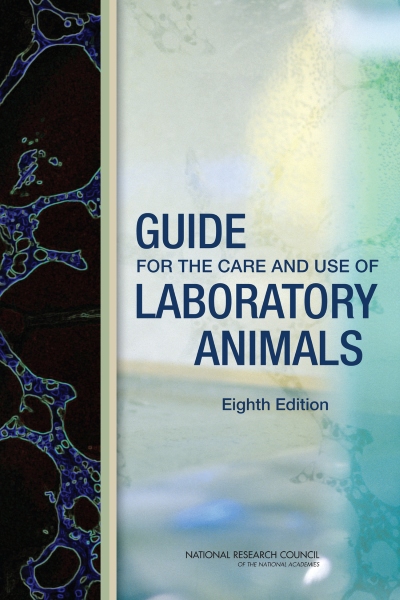
The Guide for the Care and Use of Laboratory Animals (Guide) describes currently accepted standards in the care and housing of animals used in research, the conduct of research programs, and the design and maintenance of research facilities. Through these standards, it empowers continued advancement in the humane care of research animals and in the proper conduct of research, research training, and biological testing with animals. The Guide is a publication of the Institute for Laboratory Animal Research of the National Academy of Sciences (now the Board on Animal Health Sciences, Conservation, and Research) and the product of a 13-member committee that included scientists, veterinarians, and non-scientists across many disciplines. The PHS Policy requires that institutions base their animal care and use programs on the Guide (PHS Policy IV.A.1).
AVMA Guidelines for the Euthanasia of Animals: 2020 Edition
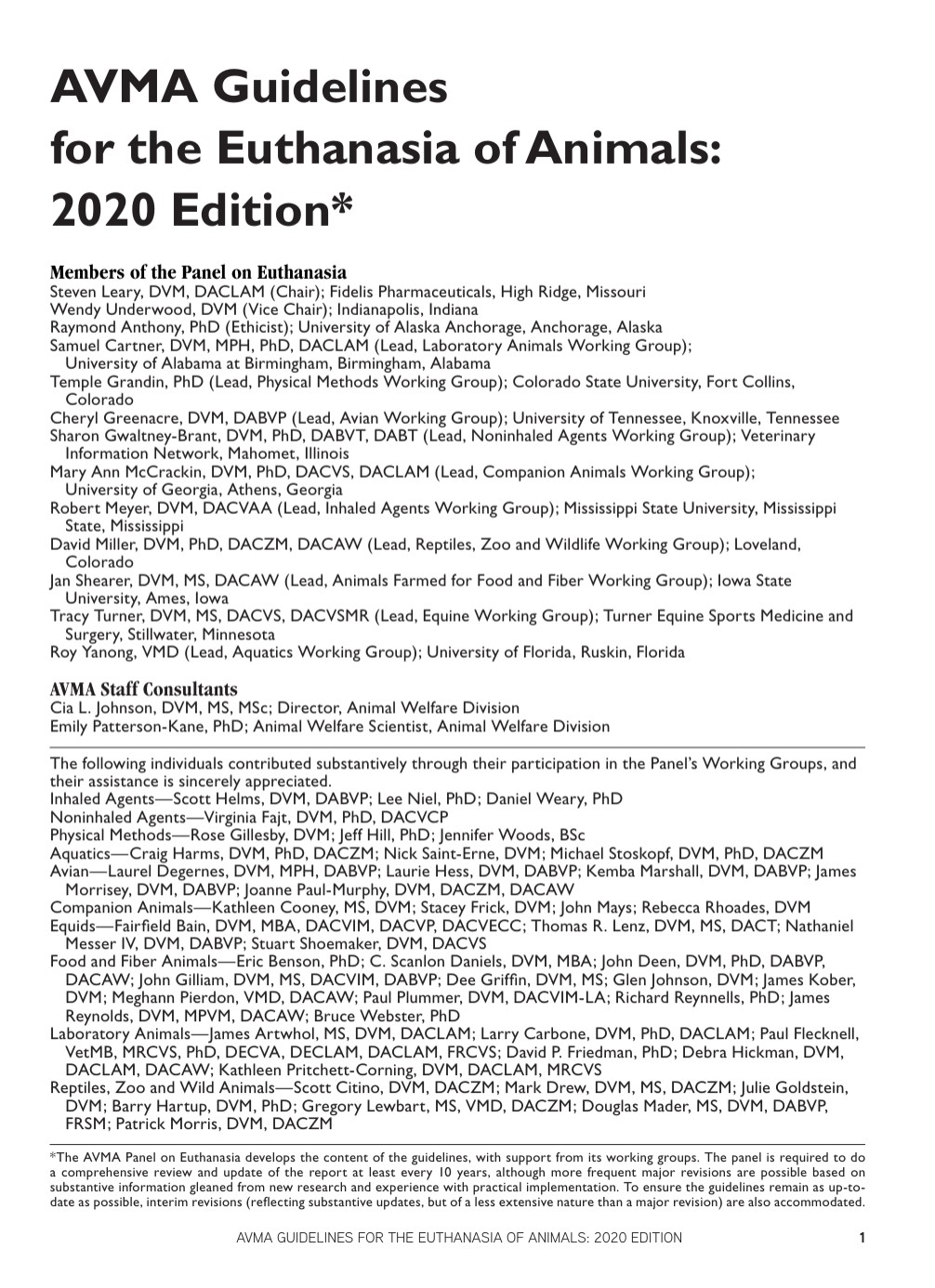
The PHS Policy, IV.C.1.g., requires that Institutional Animal Care and Use Committees (IACUCs) reviewing research animal activities determine that methods of euthanasia used will be consistent with the recommendations of the AVMA Guidelines for the Euthanasia of Animals unless a deviation is justified for scientific reasons in writing by the investigator. The current edition of the Guidelines for the Euthanasia of Animals can be found on the American Veterinary Medical Association (AVMA) website by clicking the button below:
International Guiding Principles for Biomedical Research Involving Animals: 2012 Edition
The International Guiding Principles provide the ethical framework for currently accepted approaches in the care and housing of research animals at non-domestic sites. They are published by the Council for International Organization of Medical Sciences (CIOMS) and the International Council for Laboratory Animal Science (ICLAS). Institutions with a Foreign Assurance are expected to adhere to the International Guiding Principles.
Agencies Having an MOU with OLAW
OLAW and other agencies have established memoranda of understanding (MOUs) regarding the oversight and care of animals. This extends the requirements of the PHS Policy to some activities funded by these agencies that would otherwise not be covered. Currently, these include NSF, NASA, VA, and USDA/FDA. OLAW is available for questions regarding the applicability of the PHS Policy to activities that may be affected by these MOUs.
MOU Among USDA/FDA/NIH
Animal and Plant Health Inspection Service, USDA
Primary responsibility for the Animal Welfare Act (AWA) is assigned to the U.S. Department of Agriculture (USDA), Animal and Plant Health Inspection Service (APHIS). Implementing regulations of the AWA are established in the Code of Federal Regulations, Title 9, Chapter 1, Subchapter A, Parts 1, 2, and 3. The Department has regulatory responsibility to enforce the implementing regulations. The USDA regulations establish standards for the humane treatment of laboratory animals and a registration/licensing procedure for identifying institutions that breed, sell, transport, hold, and use such animals. Compliance with the USDA regulations is monitored by an active inspection program that provides for periodic inspections of facilities that use animals for teaching, testing, and experimentation by veterinary medical officers. Serious noncompliance is dealt with by procedures that range from civil penalties, to the issuance of "cease and desist" orders, to the confiscation of animals.
Food and Drug Administration, HHS
The Food and Drug Administration (FDA) promulgated Good Laboratory Practice (GLP) regulations (21 CFR Part 58) under the Federal Food Drug and Cosmetic Act and Public Health Service Act. The GLP regulations establish administrative standards for the conduct of nonclinical laboratory studies that support or are intended to support applications for research or marketing permits for products regulated by the FDA. Compliance is assessed through an active program of inspections carried out by trained Office of Regulatory Affairs and/or product Center field inspectors. Serious noncompliance is dealt with by procedures ranging from study rejection to laboratory disqualification.
National Institutes of Health, HHS
The Office of Laboratory Animal Welfare (OLAW), Office of Extramural Research, National Institutes of Health (NIH), is responsible for the implementation and general administration of the Public Health Service (PHS) Policy on Humane Care and Use of Laboratory Animals (PHS Policy). The PHS Policy implements the Health Research Extension Act of 1985 (Public Law 99-158), and is based on the U.S. Government Principles for the Utilization and Care of Vertebrate Animals Used in Testing, Research, and Training. Standards for institutional programs and facilities are described in the Guide for the Care and Use of Laboratory Animals. Institutions receiving PHS support must have an OLAW approved Animal Welfare Assurance that describes the institutional program and sets forth institutional compliance with PHS Policy. OLAW fosters compliance through the Assurance mechanism and a national education program, and monitors compliance by evaluating institutional reports of noncompliance. Institutions are required to correct confirmed noncompliance and institute appropriate measures to prevent repeated noncompliance. Potential sanctions for continued noncompliance appear in the NIH Grants Policy Statement, Part II, under authority derived from 45 CFR § 74.14 and 42 CFR § 52.9.
USDA, FDA, and NIH share a common concern for the care and use of laboratory animals, although there are necessary operational differences among the animal welfare programs of the cooperating agencies. Congress acknowledged the need for trans-agency cooperation in the AWA by calling for the Secretary of Agriculture to consult and cooperate with other Federal departments and agencies concerned with the welfare of animals used in research, and to consult with the Secretary of Health and Human Services prior to the issuance of regulations.
Common program features include the promulgation of standards and policies aimed at promoting laboratory animal welfare, the maintenance of registries/inventories of institutions and facilities subject to agency policies and regulations, the periodic conduct of routine and "for cause" inspections or site visits, efforts designed to promote voluntary compliance, and the application of a range of sanctions when necessary.
Interagency cooperation provides an excellent opportunity to bolster individual agency efforts, achieve program benefits, and facilitate program operations. A mutually shared perspective on acceptable standards of laboratory animal care presents a consistent Federal approach and fosters compliance by regulated entities.
FDA has authority to enter into this agreement pursuant to Section 1003(b) and (c) of the Federal Food, Drug and Cosmetic Act.
NIH has authority to enter into this agreement pursuant to Section 495 of the Public Health Service Act.
Under the Animal Welfare Act (AWA) (7 USC §§ 2131 et. seq.), the Secretary of Agriculture is authorized to assure humane treatment and care for animals intended for use as pets, research, and exhibition and to cooperate with the officials of the various states or political subdivisions thereof in carrying out the purposes of this Act and of any State, local or municipal legislation or ordinance on the same subject.
The cooperating agencies agree to share information of mutual concern and interest regarding animal welfare.
This is an internal Government agreement among USDA, FDA, and NIH and does not confer any rights or benefits to any person or party. This MOU does not include any commitment by any agency to contribute or exchange or transfer funds.
This MOU does not affect or supersede any existing or future agreements or arrangements between or among the parties. This MOU and any associated agreements will be subject to the applicable policies, rules, regulations, and statutes under which the cooperating agencies operate.
Specific agency responsibilities under this Memorandum of Understanding are detailed below.
A. The cooperating agencies agree to share information contained in their respective registries/inventories/listings of organizations that fall under their purview.
B. The cooperating agencies agree to provide one another with information concerning significant adverse findings regarding animal care and use at organizations investigated, inspected, or site-visited, and the actions taken by the agency in response to the findings.
C. The cooperating agencies agree to provide one another with information regarding evidence of serious noncompliance with required standards or policies for the care and use of laboratory animals at organizations that fall under the authority of the participating agencies.
D. The cooperating agencies agree, to the extent possible, to coordinate successive evaluations and to avoid redundant evaluations of the same entities.
E. The cooperating agencies agree to consult and coordinate with each other on regulatory or policy proposals and significant policy interpretations involving animal care and use under consideration by each agency.
F. The cooperating agencies agree to provide each other with resource persons for scientific and educational seminars, speeches, and workshops related to laboratory animal welfare.
G. The cooperating agencies agree to limit the dissemination of shared information to include only those authorized FDA, USDA and NIH employees and officials who require such access in order to perform their official duties in accordance with the uses of the information as authorized by this MOU. If records provided by any cooperating agency under this agreement are the subject of a FOIA request submitted to the agency that received the records, that agency will refer the FOIA request and relevant records to the agency that provided the records for processing. If the FOIA request seeks two or more parties’ records or if the request is for records created by one agency that incorporates information provided by one or both other agencies, the agency receiving the FOIA request will forward all such requests to the respective FOIA offices for USDA, FDA, and NIH for disposition. The recipient agency shall promptly notify the agency that provided the information of any judicial order that compels the release of information.
H. The cooperating agencies recognize and acknowledge that nonpublic information shared between or among the agencies, whether written or oral, must be shared in a manner consistent with the requirements of 21 CFR 20.85 and protected from any further disclosures or use not authorized by law or regulation. All agencies will establish safeguards to ensure that any nonpublic information shared under this MOU is protected from unauthorized disclosure or use. Such safeguards help ensure compliance with other applicable laws and regulations and should include the marking of any materials as “confidential” prior to disclosure or the use of encryption technologies when appropriate.
The cooperating agencies agree to share information of mutual concern and interest regarding animal welfare.
To facilitate implementation of this agreement, the cooperating agencies each agree to designate a liaison officer to serve on a standing committee that will meet as needed, but no less than twice per year. Matters for consideration by the standing committee are to include a review of each agency's participation in this agreement, an assessment of the agreement's effectiveness, and modifications that might be necessary. As appropriate, the committee will address urgent issues and specific cases of serious noncompliance. The names of staff listed below represent the current persons or positions with these assigned roles at the date of signing of this MOU. Additional or alternative USDA, FDA, and NIH staff may be drawn to provide expertise as needed.
For the Animal and Plant Health Inspection Service:
Elizabeth Theodorson, DVM, MPH
Assistant Deputy Administrator USDA, APHIS, AC
4700 River Road,
Riverdale, MD 20737-1234
Phone: 970-494-7473
For the Food and Drug Administration:
Brianna Skinner, DVM, MPH
Senior Regulatory Veterinarian
Office of Counterterrorism and Emerging Threats
U.S. Food and Drug Administration
10903 New Hampshire Avenue
WO 1, Room 4208
Silver Spring, MD 20993
Phone: 240-402-1240
For the National Institutes of Health:
Patricia Brown, VMD, MS
Director, Office of Laboratory Animal Welfare
Office of Extramural Research
National Institutes of Health
6700B Rockledge Drive, Suite 2500, MSC 6910
Bethesda, MD 20892-6910
Phone: 301-496-7163
This agreement becomes effective on the date of last signature and continues for 5 years. It may be modified by mutual written consent of the three parties. The agreement may be terminated by any party upon a 90-day advance written notice to the other parties. At the conclusion of 5 years the three parties will consider the development of a new agreement.
For the Animal and Plant Health Inspection Service, USDA:
Signature: /s/
Name: Robert Huttenlocker, MBA
Title: Deputy Administrator, Marketing and Regulatory Programs Business Services, Animal and Plant Health Inspection Service
U.S. Department of Agriculture
Date: June 21, 2021
For the Food and Drug Administration, HHS:
Signature: /s/
Name: Janet Woodcock, MD
Title: Acting Commissioner of Food and Drugs
U.S. Department of Health and Human Services
Date: May 18, 2021
For the National Institutes of Health, HHS:
Signature: /s/
Name: Francis S. Collins, MD, PhD
Title: Director, National Institutes of Health
U.S. Department of Health and Human Services
Date: May 4, 2021
This is Amendment Number two (2) to the Memorandum of Understanding (MOU) 225-16-010 between the U.S. Department of Agriculture, Animal and Plant Health Inspection Service; the U.S. Department of Health and Human Services, Food and Drug Administration; and the U.S. Department of Health and Human Services, National Institutes of Health (each a “party”, and together, the “parties”).
The purpose of this Amendment is to update terminology from “laboratory” to “study” animals to better reflect the scope of the agreement. Specifically,
- In Section II. AGENCY RESPONSIBILITIES, under Animal and Plant Health Inspection Service, USDA, the sentence “The USDA regulations establish standards for the humane treatment of laboratory animals and a registration/licensing procedure…” is changed to “The USDA regulations establish standards for the humane treatment of study animals and a registration/licensing procedure…”
- In Section III. SHARED CONCERNS:
- first paragraph, the sentence “USDA, FDA, and NIH share a common concern for the care and use of laboratory animals,…” is changed to “USDA, FDA, and NIH share a common concern for the care and use of study animals,…”
- second paragraph, the sentence “Common program features include the promulgation of standards and policies aimed at promoting laboratory animal welfare,…” is changed to “Common program features include the promulgation of standards and policies aimed at promoting animal welfare of study animals,…”
- third paragraph, the sentence “A mutually shared perspective on acceptable standards of laboratory animal care presents a consistent Federal approach…” is changed to “A mutually shared perspective on acceptable standards of animal care presents a consistent Federal approach…”
- In Section V. SUBSTANCE OF AGREEMENT, the sentence “The cooperating agencies agree to provide one another with information regarding evidence of serious noncompliance with required standards or policies for the care and use of laboratory animals at organizations that fall under the authority of the participating agencies” is changed to “The cooperating agencies agree to provide one another with information regarding evidence of serious noncompliance with required standards or policies for the care and use of study animals at organizations that fall under the authority of the participating agencies.”
We are also extending the expiration date until the parties decide to end or alter this agreement and updating the liaison officers in Section VII. This is permissible under Section VIII—PERIOD OF AGREEMENT. Specifically, under this section, we are changing the following paragraph:
“This agreement becomes effective on the date of last signature and continues for 5 years. It may be modified by mutual written consent of the three parties. The agreement may be terminated by any party upon a 90-day advance written notice to the other parties. At the conclusion of 5 years the three parties will consider the development of a new agreement.”
The revised paragraph is:
“This agreement becomes effective on the date of last signature and continues until there is mutual agreement to end it. It may be modified by mutual written consent of the three parties. The agreement may be terminated by any party upon a 90-day advance written notice to the other parties.”
Execution of this amendment provides continuity to promote collaboration and enhance knowledge and efficiency by providing for the sharing of information of mutual concern between the Parties. All other content, terms, and conditions stated in MOU Number 225-16-010, made effective on April 29, 2016, will remain unchanged.
VII. LIAISON OFFICERS
For the Animal and Plant Health Inspection Service:
Martha Keller, DVM, MS, DACAW Director, Center for Animal Welfare
U.S. Department of Agriculture
Animal and Plant Health Inspection Service, Animal Care Mail Stop 9999
2312 E Bannister Rd Kansas City, MO 64141
For the Food and Drug Administration:
Brianna Skinner, DVM, MPH Senior Regulatory Veterinarian
U.S. Food and Drug Administration
Office of Regulatory and Emerging Science 10903 New Hampshire Avenue
White Oak Building 1 Mailstop 4305
Silver Spring, MD 20993
For the National Institutes of Health:
Axel Wolff, MS, DVM
Acting Director, Office of Laboratory Animal Welfare Office of Extramural Research
National Institutes of Health 6705 Rockledge Drive, MSC 7983
Bethesda, MD 20892
This Amendment Two, when accepted by the undersigned, will be effective on the date of the last signature.
APPROVED AND ACCEPTED:
For the Animal and Plant Health Inspection Service, USDA:
Name: Kelly Moore
Title: Administrator, Animal and Plant Health Inspection Service
U.S. Department of Agriculture
Signature: /s/
Date: 3/4/2026
For the Food and Drug Administration, HHS:
Name: Martin A. Makary, M.D., MPH
Title: Commissioner of Food and Drugs
U.S. Department of Health and Human Services
Signature: /s/
Date: 3/26/2026
For the National Institutes of Health, HHS:
Name: Jon Lorsch, Ph.D.
Title: Deputy Director, Office of Extramural Research, National Institutes of Health
U.S. Department of Health and Human Services
Signature: /s/
Date: 3/31/2026
MOU Between NIH and VA
The National Institutes of Health (NIH) Office of Laboratory Animal Welfare (OLAW) and the Department of Veterans Affairs (VA) Veterans Health Administration (VHA) Office of Research and Development (ORD)and Office of Research Oversight (ORO), hereinafter referred to as the Cooperating Agencies, collectively share a common interest in the appropriate care and welfare of laboratory animals used in research and testing. This Memorandum of Understanding (“MOU”) sets forth procedures for cooperation to assist each agency in meeting its responsibilities to ensure appropriate laboratory animal care and welfare.
- Maintain and enhance agency effectiveness by coordinating efforts and sharing resources and information, particularly in the areas of education and compliance;
- Avoid duplication of effort in achieving standards for the care and use of laboratory animals, thereby reducing regulatory burden on the VA and VA-affiliated institutions; and
- Promote harmonization among VA-sponsored activities and between VA institutions and other Public Health Service (PHS) Assured institutions.
Interagency cooperation provides an excellent opportunity to bolster individual agency efforts, achieve program benefits, and facilitate program operations. A shared perspective on acceptable standards of laboratory animal care presents a uniform Federal approach and fosters compliance with the PHS Policy on Humane Care and Use of Laboratory Animals within VA and at VA-affiliated institutions that conduct VA research.
NIH Office of Laboratory Animal Welfare (OLAW)OLAW, Office of Extramural Research, NIH, is responsible for the implementation, general administration, and interpretation of the PHS Policy on Humane Care and Use of Laboratory Animals (PHS Policy). The PHS Policy implements the Health Research Extension Act of 1985 (Public Law 99-158), and incorporates the U.S. Government Principles for the Utilization and Care of Vertebrate Animals Used in Testing, Research, and Training, and the standards for institutional programs and facilities described in the current edition of the National Academy of Sciences’ Guide for the Care and Use of Laboratory Animals (Guide).
The PHS Policy requires each institution receiving PHS support for an activity involving live, vertebrate animals to establish an appropriate institutional animal care and use program, including an Institutional Animal Care and Use Committee (IACUC) with specific responsibilities as described in the PHS Policy. Adherence to the PHS Policy and the Guide are achieved primarily through voluntary compliance with an institutional animal care and use program described in a PHS Animal Welfare Assurance (Assurance). Assurances are submitted to and must be approved by OLAW, on behalf of the Director, NIH, before PHS funds may be released for activities involving laboratory animals
In addition to the Assurance mechanism, OLAW fosters compliance with the PHS Policy through a nationwide educational program for research administrators, IACUC members, investigators, laboratory animal veterinarians, and others with responsibility for animal care and use. OLAW also conducts site visits to institutions and evaluates alleged noncompliance with the PHS Policy. Institutions are required to correct confirmed noncompliance and to institute appropriate measures to prevent recurrence. Possible sanctions for continued noncompliance without appropriate corrective actions range from exclusion of individual projects from an approved Assurance to withdrawal of approval of the institution's entire Assurance. Without coverage by an approved Assurance, PHS support may not be applied to animal-related activities of a project.
VA Veterans Health Administration (VHA)
Within VHA, VA, the Office of Research and Development (ORD) and the Office of Research Oversight (ORO) have distinct, complementary responsibilities in the effort to ensure that VA research with animals is conducted appropriately.
VHA ORD serves as the primary internal research funding and research policy formulation component within VA. It bears primary responsibility for supporting field research programs through education, training, and consultation. Support for VA field programs of research with animals is managed primarily through the office of the Chief Veterinary Medical Officer (CVMO), which is responsible for establishing VA policy about VA research with animals (VHA Handbook 1200.07), and assumes responsibility for interactions with other federal agencies (such as NIH OLAW) regarding policy and training relevant to research with animals. VA policy requires all VA animal research to be conducted in compliance with the United States Department of Agriculture (USDA) Animal Welfare Act (AWA) and Animal Welfare Regulations (AWR) (VHA Handbook 1200.07, par. 4.b(5)) and the PHS Policy (VHA Handbook 1200.07, par. 4.b(4)), regardless of whether it is supported by PHS funds. This includes accepting that OLAW's interpretation of PHS policy is definitive (PHS Policy, Section V.A.3).
VHA ORO serves as the primary VHA office to advise the VA Under Secretary for Health on matters of research compliance. With regard to VA animal research and in accordance with the requirements of VHA Directive 1058.01, ORO performs periodic prospective reviews of VA animal research programs to identify noncompliance and vulnerabilities. Further, ORO investigates reports of alleged noncompliance with the laws, regulations, and policies applicable to VA animal research when it is determined that such investigations are best conducted by an entity independent of the VA medical facility where the noncompliance is alleged to have occurred.
The VA and NIH share common interests in the appropriate care and use of laboratory animals and in the quality of the research conducted under their auspices. OLAW has statutory responsibility for implementing the PHS Policy as described above. VA recognizes the value of the standards contained within the PHS Policy in promoting high quality animal care and use programs and therefore requires compliance with them even when the animal research at a local VA medical facility is not supported with PHS funds. Compliance with PHS requirements also promotes VA adherence to the standards common to the other medical or academic institutions that affiliate with VA and/or collaborate with VA in conducting animal research.
Program features common to VA and NIH include promotion of PHS Policy standards, monitoring of standards, correction of programmatic deficiencies, promotion of voluntary compliance, and creation and implementation of educational programs that foster compliance, dissemination of information, and quality animal care.
- Interpretation of PHS Policy remains the exclusive purview of NIH/OLAW as authorized by Public Law 99-158.
- Subject to each agency’s internal guidelines and upon receiving a request, the Cooperating Agencies agree to share information of mutual concern and interest regarding animal welfare at VA medical facilities and VA-affiliated PHS-assured institutions, including, but not limited to, evidence of serious noncompliance with established standards for the care and use of laboratory animals, significant adverse findings of investigations, inspections, or site visits regarding animal care and use, and documentation of actions taken by the agencies in response to the findings.
- The Cooperating Agencies agree to limit to internal agency officials who have a need to know, the dissemination of shared information received. If a Cooperating Agency receives a Freedom of Information Act request for records provided by the other agency, the recipient agency will refer the request to the agency that provided the records. The recipient agency will promptly notify the agency that provided the information of any judicial order that compels the release of information.
- The Cooperating Agencies agree, to the extent possible, to avoid redundant evaluations of VA and VA-affiliated animal care and use programs and duplication of respective efforts, to minimize the burden on Assured institutions and on the Cooperating Agencies.
- Subject to item IV.2 above, ORO and OLAW will consult with one another, as necessary, with regard to investigations of serious noncompliance in VA research with animals.
- Subject to item IV.2 above, the ORD CVMO will share information relevant to VA compliance with PHS Policy with OLAW and ORO.
- OLAW agrees to negotiate Animal Welfare Assurances from VA or VAaffiliated institutions that do not receive direct PHS support for activities involving live vertebrate animals.
- At the request of ORO or ORD, OLAW will provide substantive review and consultation of internal VA policies and educational materials related to animal research for compliance with PHS Policy and harmonization of standards.
- The Cooperating Agencies agree to work collaboratively to co-sponsor educational meetings and workshops, to collaborate on online training, and to provide each other with resource persons, to the extent possible, for seminars, presentations, and workshops related to laboratory animal welfare and their respective agency responsibilities.
- Nothing in this MOU shall limit or otherwise affect each party’s ability to exercise its own authorities or gives either party approval power over the exercise of the other party’s authorities. Nothing in this MOU is intended or should be construed to authorize the transfer of funds between the Cooperating Agencies.
The Cooperating Agencies each agree to designate at least one liaison officer who will represent the agency in the implementation of this MOU. The liaison officers will coordinate exchanges of information as necessary and the provision of other items under the Substance of MOU section (IV) described above.
For the NIH Office of Laboratory Animal Welfare:
Patricia A. Brown, VMD, MS, DACLAM
Director, Office of Laboratory Animal Welfare
Office of Extramural Research
National Institutes of Health
RKL 1, Suite 360, MSC 7982
6705 Rockledge Drive
Bethesda, MD 20892-7982
Phone: 301-496-7163
For the VHA Office of Research and Development:
George W. Lathrop, Jr., DVM, MS, DACLAM
Chief Veterinary Medical Officer
Office of Research and Development (151V)
Veterans Health Administration
Department of Veterans Affairs
1670 Clairmont Road
Decatur, GA 30033
Phone: 404-731-8237
For the VHA Office of Research Oversight:
James M. Trout, PhD
Director, Research Safety & Animal Welfare (RSAW)
Office of Research Oversight (10R)
Veterans Health Administration
Department of Veterans Affairs
810 Vermont Ave. NW
Washington, DC 20420
Phone: 202-632-7677
This MOU becomes effective on the date of the last signature and continues for 5 years. It may be modified by mutual written consent. Either agency, upon 90-day advance written notice to the other party, may terminate this MOU. At the conclusion of 5 years the parties will consider the development of a new MOU.
For the Office of Laboratory Animal Welfare, OER, NIH:
Date: 01/04/2023
Name: Michael Lauer, M.D.
Title: Deputy Director for Extramural Research
National Institutes of Health
U.S. Department of Health and Human Services
1 Center Drive (MSC 0152)
Room 144
Bethesda, MD 20892-0152
Phone: 301-496-1096
For the Office of Research and Development, VHA, VA:
Date: 01/03/2023
Name: Rachel B. Ramoni, DMD, ScD
Title: Chief Research and Development Officer (10P9)
Office of Research and Development
Veterans Health Administration
1100 1st Street, NE, Rm 622
Washington, DC 20000
U.S. Department of Veterans Affairs
For the Office of Research Oversight, VHA, VA:
Date: 01/03/2023
Name: Doug Bannerman, PhD
Title: Executive Director
Office of Research Oversight (10RO)
Veterans Health Administration
810 Vermont Ave. NW
Washington, DC 20420
U.S. Department of Veterans Affairs
MOU Between NIH and NASA
This MOU sets forth the terms under which the National Aeronautics and Space Administration (NASA) intends to transfer funds via Interagency Agreement to the Office of Laboratory Animal Welfare (OLAW), Office of Extramural Research, Office of the Director, National Institutes of Health (NIH) (hereafter referred to as agencies), for services provided in ensuring compliance with the Public Health Service Policy on Humane Care and Use of Laboratory Animals (PHS Policy) and the Guide for the Care and Use of Laboratory Animals for all NASA grants, contracts, cooperative agreements involving research with live vertebrate animals.
OLAW is responsible for the general administration and implementation of the PHS Policy. The PHS Policy, promulgated in 1986 to implement the Health Research Extension Act of 1985, requires institutions to establish and maintain proper measures to ensure the appropriate care and use of all animals involved in research, research training, and biological testing activities conducted or supported by the PHS. OLAW is mandated, through the PHS Policy, to “advise awarding units and awardee institutions concerning the implementation of this Policy”.
The purpose of this MOU is to outline the process for technical and administrative services to be performed by OLAW for the NASA. NIH requires OLAW to charge for cost recovery for the services provided to agencies outside of NIH. OLAW has developed a fee structure that is based primarily on the number of domestic Animal Welfare Assurances administered by OLAW and supported by the annual OLAW operating budget. As NASA currently holds four domestic Assurances, the charges are a base amount. The cost for these services is subject to annual adjustment.
These services include general and comprehensive administration and coordination of the PHS Policy to include:
- Negotiate, review and approve Animal Welfare Assurances in support of NASA grants, contracts, cooperative agreements and intramural activities;
- Distribute lists of approved Assurances on the OLAW website;
- Evaluate allegations of noncompliance with the PHS Policy;
- Advise and educate on implementation of the PHS Policy;
- Provide guidance on interpretation of the PHS Policy;
- Authorize waivers to the PHS Policy; and
- Conduct site visits to selected institutions.
- Interpretation of, and determination of noncompliance with, PHS Policy remain the exclusive purview of NIH/OLAW as authorized by Public Law 99-158.
- At the request of NASA, OLAW will negotiate Animal Welfare Assurances for NASA- supported institutions that do not receive PHS support for activities involving live vertebrate animals. NASA-supported activities include use of NASA resources, funding, personnel, or equipment (e.g. ground-based research, the International Space Station (ISS), or its equivalent) in support of NASA grants, contracts, cooperative agreements and intramural activities.
- Subject to each agency's internal policies and guidelines and upon receiving a request, the NASA and OLAW agree to share information of mutual concern and interest regarding animal welfare at NASA-supported institutions, including, but not limited to, evidence of serious noncompliance with standards for the care and use of animals in regulated activities, significant adverse findings regarding animal care and use investigated, inspected, or site-visited, and actions taken by the agencies in response to the findings.
- NASA and OLAW will consult with one another about investigations of noncompliance at institutions with PHS Assurances and NASA funding. NASA and OLAW will notify each other of information concerning potential noncompliance involving NASA-supported activities at institutions with PHS Assurances
- NASA will share information relevant to NASA-supported activities not in compliance with PHS Policy with OLAW.
- NASA-supported PHS-Assured entities will report incidents of noncompliance to OLAW and any funding Federal agency. The Institutional Animal Care and Use Committee (IACUC), through the Institutional Official, shall promptly provide OLAW with a full explanation of the circumstances and actions taken with respect to:
- any serious or continuing noncompliance with the PHS Policy;
- any serious deviations from the provisions of the Guide; or
- any suspension of an activity by the IACUC.
- OLAW will receive and evaluate allegations of noncompliance with the PHS Policy that arise during the course of the NASA supported research, regardless of location, and including but not necessarily limited to, each of the NASA Centers, the ISS, the Principal Investigator’s home institution or any related location where NASA resources were utilized in support of regulated animal activities.
- NASA and OLAW agree to limit the dissemination of shared information received to internal agency officials who have a need to know. If either agency receives a Freedom of Information Act request for records provided by the other agency, the recipient agency will refer the request to the agency that provided the records. The recipient agency will promptly notify the agency that provided the information of any judicial order that compels the release of information.
- NASA and OLAW agree to work collaboratively to co-sponsor educational meetings and workshops, to collaborate on online training, and to provide each other with resource persons, to the extent possible, for seminars, presentations and workshops related to laboratory animal welfare and their respective agency responsibilities.
- Nothing in this agreement shall limit or otherwise affect each party's ability to exercise its own authorities or gives the other party approval power over the exercise of the other party's authorities.
- OLAW will direct the posting of a Notice of Memorandum of Understanding Between NIH and NASA Concerning Laboratory Animal Welfare to the NIH Grants and Funding, NIH Central Resource for Grants and Funding Information website.
- OLAW and NASA will communicate the relationship between OLAW and NASA as described in this MOU at relevant meetings, conferences, and other venues, if and when appropriate.
This work is in support of the Health Research Extension Act of 1985, Public Law 99-158, Sec. 495 requiring that the Secretary, Department of Health and Human Services, acting through the Director of NIH, establish guidelines for the proper care of animals used in biomedical and behavioral research.
The Cooperating Agencies each agree to designate at least one liaison officer who will represent the agency in the implementation of this MOU. The liaison officers will coordinate exchanges of information as necessary and the provision of other items under the Substance of MOU section (IV) described above.
National Institutes of Health
Jane Na, DVM, CPIA
Director, Division of Assurances
Office of Laboratory Animal Welfare
Office of Extramural Research, Office of the Director, NIH
6700B Rockledge Drive
Suite 2500, MSC 6910
Bethesda, MD 20892
301.402.1922
[email protected]
National Aeronautics and Space Administration
James D. Polk, DO, EdD, MS, MMM, CPE, FACOEP, FAsMA
Chief Health and Medical Officer and Health and Medical Technical Authority
NASA Office of the Chief Health and Medical Officer
NASA Headquarters
Mail Code QA, Room 2K22
300 E Street, SW
Washington, DC 20546
202.358.1959
[email protected]
Mark Weyland
Director, Health Operations and Oversight
NASA Office of the Chief Health and Medical Officer
NASA Headquarters
Mail Code QA, Room 2M34
300 E Street, SW
Washington, DC 20546
281.483.6193
[email protected]
This agreement covers the period October 1, 2024 through September 30, 2029.
Payments made pursuant to this MOU will be charged as an annual lump sum to be paid via Interagency Agreement each fiscal year during the period of agreement.
However, this MOU is neither a fiscal nor a funds obligation document. Nothing in this MOU authorizes or is intended to obligate the Parties to expend, exchange, or reimburse funds, services, or supplies, or transfer or receive anything of value. Nothing in this MOU may be construed to obligate the NASA or OLAW to any current or future expenditure of resources in advance of the availability of appropriations. Nor does this MOU obligate the NASA or OLAW to spend funds on any particular project or purpose, even if funds are available.
This agreement may be modified or canceled within 30 days and at any time with the written concurrence of both parties by written notice by either the Requesting or Servicing Agency. If this agreement is canceled, any implementing contract/order may also be canceled. If the IAA is terminated, the agencies shall agree to the terms of the termination, including costs attributable to each party and the disposition of awarded and pending actions.
Should disagreement arise under this agreement, or amendments and/or revisions thereto, that cannot be resolved at the Division Director level, the area(s) of disagreement shall be stated in writing by each party and presented to the other party at the Assistant Director or equivalent level for consideration.
Axel Wolff, MS, DVM
Acting Director, OLAW, NIH
Signature: /s/
Date: 7/19/2024
James D. Polk, DO, EdD, MS, MMM, CPE, FACOEP, FAsMA
Chief Health and Medical Officer, NASA
Signature: /s/
Date: 8/12/2024
Mark Weyland
Director, Health Operations and Oversight, NASA
Signature: /s/
Date: 8/13/2024
MOU Between NIH and NSF
This MOU sets forth the terms under which the National Science Foundation (NSF) intends to transfer funds via Interagency Agreement to the Office of Laboratory Animal Welfare (OLAW), Office of Extramural Research, Office of the Director, National Institutes of Health (NIH) (hereafter referred to as agencies), for services provided in ensuring compliance with the Public Health Service Policy on Humane Care and Use of Laboratory Animals (PHS Policy) for all NSF grants and cooperative agreements involving research with live vertebrate animals.
OLAW is responsible for the general administration and implementation of the PHS Policy. The PHS Policy, promulgated in 1986 to implement the Health Research Extension Act of 1985, requires institutions to establish and maintain proper measures to ensure the appropriate care and use of all animals involved in research, research training, and biological testing activities conducted or supported by the PHS. OLAW is mandated, through the PHS Policy, to “advise awarding units and awardee institutions concerning the implementation of this Policy”.
NSF is acting pursuant to the National Science Foundation Act of 1950 as amended, 42 USC 1861 et seq.
NIH is acting under the authority of the Economy Act (31 U.S.C. 1535/FAR 17.5).
These authorizations for the agencies, together with the internal policies and procedures of each, define the authority of these agencies to enter into this MOU.
The purpose of this MOU is to outline the process for technical and administrative services to be performed by OLAW for the NSF. NIH requires OLAW to charge for cost recovery for the services provided to agencies outside of NIH. OLAW has developed a fee structure that is based primarily on the number of domestic Animal Welfare Assurances administered by OLAW and supported by the annual OLAW operating budget. As NSF currently holds no domestic Assurances, the charges are a base amount. The cost for these services is subject to annual adjustment.
These services include general and comprehensive administration and coordination of the PHS Policy to include:
- Negotiate, review and approve Animal Welfare Assurances in support of NSF grants, and cooperative agreements;
- Distribute lists of approved Assurances on the OLAW website;
- Advise and educate on implementation of the PHS Policy;
- Provide guidance on interpretation of the PHS Policy;
- Evaluate allegations of noncompliance with the PHS Policy;
- Authorize waivers to the PHS Policy; and
- Conduct site visits to selected institutions.
- Interpretation of, and determination of noncompliance with, PHS Policy remain the exclusive purview of NIH/OLAW as authorized by Public Law 99-158.
- Subject to each agency's internal policies and guidelines and upon receiving a request, the NSF and OLAW agree to share information of mutual concern and interest regarding animal welfare at NSF-affiliated PHS-assured institutions, including, but not limited to, evidence of serious noncompliance with standards for the care and use of laboratory animals, significant adverse findings regarding animal care and use investigated, inspected, or site-visited, and actions taken by the agencies in response to the findings.
- NSF and OLAW agree to limit the dissemination of shared information received to internal agency officials who have a need to know. If either agency receives a Freedom of Information Act request for records provided by the other agency, the recipient agency will refer the request to the agency that provided the records. The recipient agency will promptly notify the agency that provided the information of any judicial order that compels the release of information.
- Subject to item 2 above, NSF and OLAW will consult with one another with regard to investigations of noncompliance at NSF-affiliated institutions holding a PHS Assurance. NSF and OLAW will notify each other of information concerning potential noncompliance at NSF-affiliated institutions with PHS Assurances.
- Subject to item 2 above, NSF will share information relevant to NSF-affiliated institution compliance with PHS Policy with OLAW.
- At the request of NSF, OLAW will negotiate Animal Welfare Assurances for NSF-affiliated institutions that do not receive direct PHS support for activities involving live vertebrate animals.
- Assured Institutions with NSF funding will report incidents of noncompliance to OLAW. The Institutional Animal Care and Use Committee (IACUC), through the Institutional Official, shall promptly provide OLAW with a full explanation of the circumstances and actions taken with respect to:
- any serious or continuing noncompliance with the PHS Policy;
- any serious deviations from the provisions of the Guide, or
- any suspension of an activity by the IACUC.
- NSF and OLAW agree to work collaboratively to co-sponsor educational meetings and workshops, to collaborate on online training, and to provide each other with resource persons, to the extent possible, for seminars, presentations and workshops related to laboratory animal welfare and their respective agency responsibilities.
- Nothing in this agreement shall limit or otherwise affect each party's ability to exercise its own authorities or gives the other party approval power over the exercise of the other party's authorities.
This work is in support of the Health Research Extension Act of 1985, Public Law 99-158, Sec. 495 requiring that the Secretary, Department of Health and Human Services (HHS), acting through the Director of NIH, establish guidelines for the proper care of animals used in biomedical and behavioral research.
National Institutes of Health
Jane Na, DVM, CPIA,
Director, Division of Assurances
Office of Laboratory Animal Welfare
OER, OD, NIH
6700B Rockledge Drive
Suite 2500
Bethesda, MD 20817
(301) 402-1922
[email protected]
National Science Foundation
Edda Thiels, PhD
Program Director
Directorate for Biological Sciences
National Science Foundation
2415 Eisenhower Ave
Suite 12000
Alexandria, VA 22314
(703) 292-8167
[email protected]
This agreement covers the period October 21, 2020, through October 20, 2025.
This MOU may be amended only by written agreement of the parties.
This MOU can be terminated with 90 days advance written notice of termination by either party, or sooner by mutual written consent of both parties.
Payments made pursuant to this MOU will be charged as an annual lump sum to be paid via Interagency Agreement at the beginning of each fiscal year during the period of agreement.
However, this MOU is neither a fiscal nor a funds obligation document. Nothing in this MOU authorizes or is intended to obligate the Parties to expend, exchange, or reimburse funds, services, or supplies, or transfer or receive anything of value. Nothing in this MOU may be construed to obligate the NSF or OLAW to any current or future expenditure of resources in advance of the availability of appropriations. Nor does this MOU obligate the NSF or OLAW to spend funds on any particular project or purpose, even if funds are available.
Resolution of Disagreements
Should disagreement arise under this agreement, or amendments and/or revisions thereto, that cannot be resolved at the Division Director level, the area(s) of disagreement shall be stated in writing by each party and presented to the other party at the Assistant Director or equivalent level for consideration.
Joanne S. Tornow, PhD
Assistant Director,
Directorate for Biological Sciences
National Science Foundation
Signature: /s/
Date: October 21, 2020
Michael Lauer, MD
Deputy Director for Extramural Research
National Institutes of Health
Signature: /s/
Date: October 13, 2020
Patricia Brown, VMD, MS
Director, Office of Laboratory Animal Welfare
National Institutes of Health
Signature: /s/
Date: October 13, 2020
This document constitutes an Amendment to the Memorandum of Understanding ("MOU") entered into on October 1, 2015, and amended for a 5-year extension in October 2020, by the U.S. National Science Foundation (NSF) and the Office of Laboratory Animal Welfare, Office of Extramural Research, Office of the Director, National Institutes of Health (NIH) regarding the transfer of funds via Interagency Agreement for services provided in ensuring compliance with the Public Health Service Policy on Humane Care and Use of Laboratory Animals for all NSF grants and cooperative agreements involving research with live vertebrate animals.
Considering the need for extending the duration of the MOU pursuant to the Modification/Cancellation clause of the MOU, the MOU is extended for 5 years for the period October 1, 2025, through September 30, 2030, or for 5 years from the date of the last signature with the following modification:
In the SUBSTANCE OF AGREEMENT section of the 2015 MOU, the MOU is amended by adding the following sentence to the end of para. 3:
“To the extent the information shared between the parties constitutes information subject to the Privacy Act of 1974, 5 U.S.C. 552, or is otherwise protected from disclosure under applicable Federal law, the parties understand that such information is to be treated as confidential, is to be shared only by secure means and otherwise safeguarded from unauthorized use, sharing, or disclosure, and that any suspected or confirmed breach of the information is to be reported immediately to the party that shared it.”
The Liaisons are updated to reflect the current agency contacts:
LIAISONS
National Institutes of Health
Jane Na, DVM, CPIA,
Director, Division of Assurances
Office of Laboratory Animal Welfare
OER, OD, NIH
6700B Rockledge Drive
Suite 2500
Bethesda, MD 20817
(301) 402-1922
[email protected]
National Science Foundation
Edda Thiels, PhD
Program Director
Directorate for Biological Sciences
National Science Foundation
2415 Eisenhower Ave
Suite 12000
Alexandria, VA 22314
(703) 292-8167
[email protected]
Except as modified by this amendment, all other terms and conditions of this agreement remain unchanged.
APPROVED AND ACCEPTED
Susan Marqusee, MD, PhD
Assistant Director
Directorate for Biological Sciences
National Science Foundation
Signature: /s/
Date: June 11, 2025
Jon Lorsch, PhD
Acting Deputy Director for Extramural Research
Office of Extramural Research, Office of the Director, NIH
Signature: /s/
Date: May 14, 2025
Axel Wolff, MS, DVM
Acting Director
Office of Laboratory Animal Welfare
Office of Extramural Research, Office of the Director, NIH
Signature: /s/
Date: May 14, 2025