 An official website of the United States government


Updated Small Business Foreign Risk Reviews to Provide More Information and an Opportunity to Address Certain Risks
NIH has updated the foreign security risk assessment process for Small Business Innovation Research (SBIR) and Small Business Technology Transfer (STTR) applications (NOT-OD-27-017). Under the updated process, applicants may receive more specific information about which individual or entity is associated with an identified foreign security risk. In certain circumstances, applicants may also have an opportunity to address that risk during the current award consideration process by removing or replacing the relevant individual or entity, rather than resubmitting a revised application.
These changes are intended to give small businesses clearer, more actionable information about foreign security risks while maintaining necessary protections for sensitive national security information. Any opportunity to address a risk during the current award process will be available only when:
- NIH determines that the risk can be resolved in a timely manner
- The proposed change would not require additional scientific and technical peer review
Why do we conduct foreign risk assessments?
Protecting U.S. investment in biomedical innovation from foreign security risks is an important part of the small business programs. Before an SBIR or STTR award can be made, NIH conducts a foreign risk assessment as required by law (see this Nexus article). This assessment is separate from the independent expert assessment that peer reviewers make regarding the scientific and technical merit of an application.
The assessment considers several statutorily-designated areas, including:
- Foreign ownership and financial ties
- Foreign affiliations
- Business and investment relationships
- Technology licensing agreements and joint ventures
- Cybersecurity practices
- Patent activity
- Certain relationships involving owners, covered individuals, and other key personnel
These reviews help safeguard federally funded technologies, intellectual property, research, and data while supporting U.S. small businesses working to advance biomedical innovation.
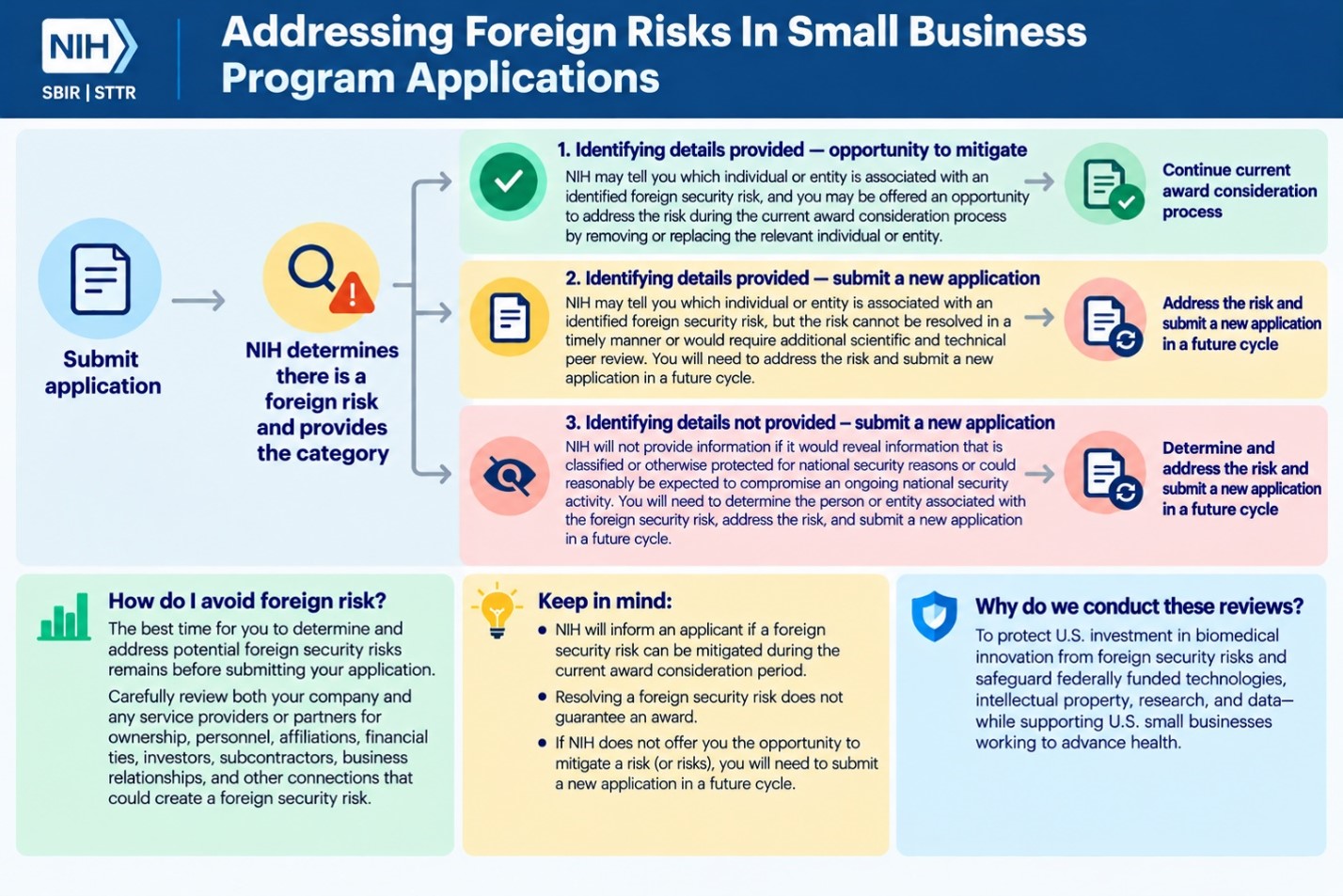
What Has Changed?
First, applicants may be told which individual or entity is associated with an identified security risk.
- NIH will not provide information if it reveals information that is classified, protected for national security reasons, or compromises an ongoing national security activity.
- NIH will continue to tell the small business which foreign risk denial category is preventing an award.
Second, some applicants may be allowed to address an identified risk without submitting a new application.
- If NIH determines that a security risk can be addressed in a timely manner by removing or replacing the relevant individual or entity, an applicant may be offered this opportunity as part of the current award consideration process. The applicant should carefully follow the instructions provided by NIH staff during the Just-In-Time (JIT) process and respond promptly.
- If NIH determines that removing or replacing the individual or entity would materially affect the scientific and technical merit of the application as evaluated during peer review, a change to the current application will not be allowed. (For example, if the change would affect the project’s specific aims or research approach; the expertise, role, or contribution of project personnel; or the facilities, resources, or collaborative arrangements available to carry out the work.)
Responding to the concerns heard from the small business community, this represents an important change from the prior process, under which the only course of action for an applicant receiving a foreign risk denial would be to self-identify the specific person or entity causing the risk, modify their project to remove the risk, and submit another application in a future cycle.
Keep in mind:
- Applicants should not assume that a mitigation opportunity will be available for every foreign security risk.
- Resolving an identified security risk does not guarantee an award. Foreign risk assessment is one component of the overall award process. Even when a security risk is successfully addressed, NIH may decide not to move forward with an award based on other funding considerations.
- If addressing the risk would require a change that warrants additional scientific and technical peer review, the applicant would need to address the risk and submit a new application for consideration in a future application cycle.
What Has Not Changed?
The best time for applicants to determine and address potential foreign security risks is still before submitting their application.
Small businesses should carefully review their ownership, personnel, affiliations, financial obligations, investments, business relationships, licensing arrangements, joint ventures, cybersecurity practices, and other relationships covered by the foreign risk requirements before applying and when completing the required Foreign Disclosure Form.
Since foreign-risk assessment began in 2023, more than half of U.S. Department of Health and Human Services (HHS) denials have involved foreign risks associated with consultants, contractors, or subawards. Before selecting a service provider or partner, applicants should understand its ownership, parent and subsidiary companies, investors, subcontractors, and other relationships that could create a security risk associated with a foreign country of concern. Our case studies and other updated resources can help innovators ask the right questions before entering into a relationship that could jeopardize an SBIR or STTR award.
Supporting Security and Innovation
NIH’s SBIR and STTR programs play an important role in transforming promising discoveries into technologies, products, and services that improve health. Protecting those investments from foreign security risks and supporting U.S. innovators are complementary goals. And, with this updated approach, we can provide greater transparency and a more actionable path forward for small businesses while maintaining the safeguards required to protect U.S. research and innovation.
Additional Resources: