 An official website of the United States government


From Scientific Learners to Leaders: Three New Parent Research Education Funding Opportunities, with Perspectives from NIH Institutes, Centers, and Offices
As part of NIH's broader effort to simplify the funding landscape, we’re pleased to highlight three new parent funding opportunities under the NIH Research Education Program (R25). Similar to updates to career development, loan repayment, and predoctoral/postdoctoral transition programs, these new research education programs provide a simpler framework for supporting research education activities while helping NIH develop the scientific workforce of the future (a continued and long-standing NIH priority). Please also plan to join us on November 5, 2026, at 2:00 p.m. ET for a webinar discussing these new funding opportunities further (more information coming soon).
What Makes These New Programs Unique
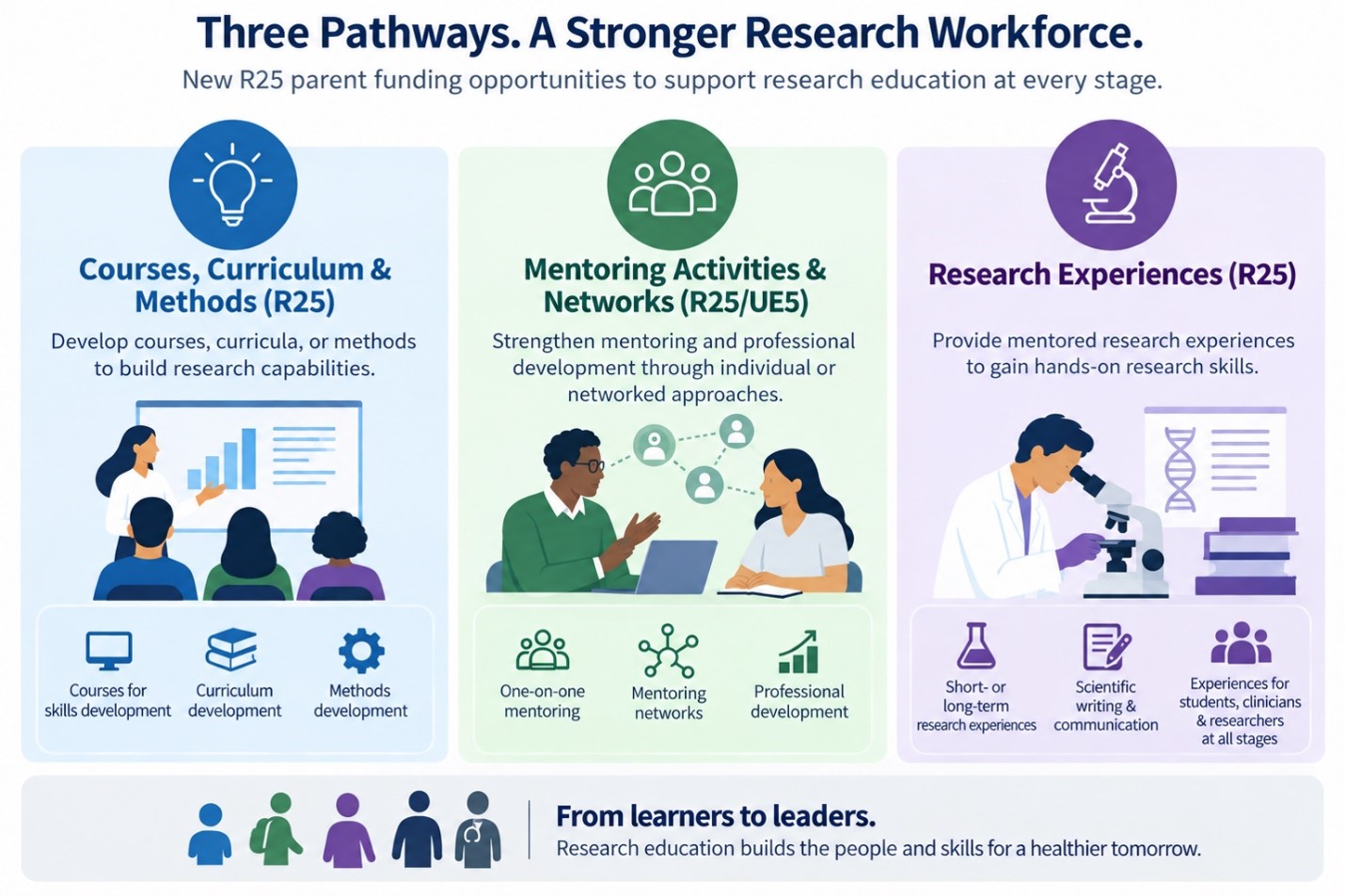
NIH’s research education programs are broader than, but still complement, traditional research training. Through these Notices of Funding Opportunity (NOFOs), NIH supports organizations in developing and implementing research education programs that help develop skills and methods, strengthen mentoring and professional networks, and enhance research experiences. They are also designed to reach participants across educational and career stages, from high school students to established investigators.
And instead of having several different, yet similar, funding opportunities spread across various NIH Institutes, Centers, or Offices (ICOs), these new parent opportunities are easier to use with the same application and review guidance.
The table below can help you identify which opportunity is the best fit.
| Funding opportunity | What it supports | Examples of Supported Activities |
|---|---|---|
| Courses, Curriculum & Methods (PA-27-034) — R25 | Programs that develop research skills, curricula, or methods | Courses that build practical research skills; new curricula, methods, or instructional approaches; programs combining didactic and hands-on experiences; and cross-disciplinary or cross-institutional partnerships. |
| Mentoring Activities & Networks (PA-27-035) — R25/UE5 | Programs that provide mentoring, professional development, and career guidance tailored to participants’ needs and career stages. | National or regional mentoring networks; mentoring that provides scientific expertise, professional guidance, resources, and career development. Single-organization programs are allowed. Awards support an R25 grant or UE5 cooperative agreement. |
| Research Experiences (PA-27-036) — R25 | Programs that provide mentored, hands-on research experiences for participants’ developmental and career-stage needs. | Short-term through longer-term research experiences, often paired with complementary activities such as scientific writing, presentation skills, and other research or career-development activities. |
In order to identify the opportunity that best matches your program, applicants are encouraged to keep a few important considerations in mind before applying:
- Start with the program’s primary purpose. Complementary activities are allowed—for example, a research experience may incorporate mentoring—but select the funding opportunity that best reflects the main focus of your proposed program.
- Consider ICO fit early. Your program should align with the scientific mission and programmatic priorities of a participating ICO. Applicants should also carefully review the organizations listed in the specific NOFO, as participation may vary by opportunity. Prospective applicants are strongly encouraged to reach out to relevant ICO program staff early in the process.
- Read the NOFO and application instructions carefully. Requirements vary by opportunity and may include specific Research Education Program Plan components, page limits, participant requirements, budgets, and other application instructions.
- Keep research education distinct from federally supported training. Proposed activities must be distinct from training programs already receiving federal support, such as NRSA T32 awards, and cannot be used to replace or circumvent NRSA mechanisms.
- Remember that a strong peer review outcome does not by itself ensure funding. ICOs consider scientific and technical merit alongside programmatic priorities, availability of funds, and other considerations when making funding decisions. Learn more about NIH’s Unified Funding Strategy from this recent conversation.
Below are additional insights and advice from some participating ICOs for prospective applicants, ranging from broad scientific priorities to more specific program requirements. Applicants are encouraged to consult the linked ICO profile pages for additional information. Click on the ICO name to expand their information.
NIA supports educational activities focused on research experiences and courses or curricula for skills and methods development that expand the aging and Alzheimer’s disease and related dementias research workforce. NIA welcomes innovative programs that support:
- 1-2 year intensive research experiences for recent college graduates
- 8-14 week hands-on summer research experiences for high school students, undergraduates, or science teachers
- 1-12 week short courses in state-of-the-art clinical research skills for future trialists
- Intensive, mentored research and exploratory development immersion experiences for early career scientists that may involve regulatory science, intellectual property, scientific communication, market analysis, biomedical product development, and entrepreneurship during the academic year, the summer, or a combination, for a minimum of 8 weeks per unique experience.
NIA considers these applications only during its January Council round. Applicants are encouraged to contact NIA program staff early to discuss program fit. NIA's profile page provides additional information.
NIEHS supports R25 applications focused either on skills development or summer research experiences in the environmental health sciences. NIEHS welcomes programs that address how exposures to toxic environmental insults:
- Impact health or alter biological processes
- Contribute to disease initiation, progression, or morbidity
- Inform the development of prevention and intervention strategies to reduce environmentally induced diseases
For skills or curriculum development, applications can focus on researchers across career stages and are encouraged to use innovative approaches to identify and address a gap in environmental health research training. Applicants proposing summer research experiences, however, are encouraged to focus on either high school students, undergraduates, or science teachers. To create a stronger and more cohesive program, the research projects, seminars, and other activities should be appropriately tailored to their education level and experience. Taken together, these activities advance a key priority of the NIEHS Strategic Plan: recruiting and training the next generation of researchers studying how environmental exposures affect human health. NIEHS' profile page provides additional information.
NCI’s Research Education Program complements efforts to develop the cancer research workforce across cancer prevention, control, behavioral and population sciences, diagnosis, treatment, translational research, and foundational cancer research. We welcome all cancer-focused projects, with the following program-specific considerations:
- Training must be completed within 12 months for each cohort participating in Courses for Skills Development, Research Experiences, and Mentoring Activities & Networks.
- NCI prioritizes applications focused on Skills Development for the Courses, Curriculum & Methods opportunity.
- For Mentoring Activities & Networks, NCI prioritizes applications that prepare postdoctoral scholars for scientific research careers or early career faculty to establish and lead academic research labs.
We also encourage applicants consider recruiting participants beyond the recipient organization to broaden participation in cancer research education programs. NCI's profile page provides additional information.
NEI will use these new parent opportunities to strengthen research education, high-quality mentoring programs, and hands-on research experiences aligned with its mission and the evolving needs of the biomedical research community. Our priorities center on translational vision research, ocular imaging technologies, cell and tissue engineering, low vision and blindness rehabilitation strategies, data science, new approach methodologies, and artificial intelligence/machine learning. NEI welcomes programs that have a participant-focused approach providing enhanced opportunities for early career researchers and clinician scientists such as:
- Specialized short courses that build advanced skills and knowledge
- Research experiences across educational and professional career stages
- Certificates, badges, or other credentials, when appropriate, that demonstrate participants’ expertise and enhance their career trajectories
When applying, researchers should clearly explain their program’s motivations, needs, and public health impact with relevance to NIH priorities. Applicants should explicitly describe the curriculum design or research experience, with clear outcomes and metrics for success. NEI's profile page provides additional information, and questions may be sent to [email protected].
Through our R25 programs, we move towards fulfilling the research training needs outlined in our strategic plan, supporting a workforce that can understand human development, improve reproductive health, enhance the lives of children and adolescents, and optimize abilities for all. Moreover, these programs help expand learning opportunities for our workforce pipeline well beyond what even the most outstanding single research setting can provide. For example, we support programs that bring together cadres of participants for intensive hands-on lab training, and specialized remote didactic training led by experts from across the country. The cohesion of the R25 cohorts across a training cycle also provides a broad swath of collaborations and networking opportunities outside of one’s home institution, something not always feasible in a typical conference setting.
When considering to apply, researchers should think clearly about the need the program would fill before beginning to plan the structure and content. Once that is in mind, then consider talking to NICHD program staff well in advance of a submission deadline to tailor your program to the latest priorities, programmatic gaps, and requirements. NICHD's profile page provides additional information.
The new Parent opportunities create a valuable, more flexible platform for NIAID to support well-defined educational, skill development, mentoring, and leadership activities that complement our existing workforce programs across different career stages, institutions, and disciplines, rather than duplicate them. Importantly, they allow us to build interdisciplinary partnerships, broaden access to research experiences, and evaluate which educational models most effectively prepare participants for biomedical research careers.
We seek applications aligned with our mission-critical workforce needs and research priorities (outlined in our new strategic plan), including for infectious diseases, immunology, allergic diseases, clinical and translational research, and the development of innovative therapeutics and diagnostics. Applicants are advised to consult NIAID staff to discuss their proposed curriculum, research, or mentoring experience ideas early, to ensure they meet educational and workforce development criteria, participant eligibility requirements, and budget constraints. NIAID's profile page provides additional information.
NIDCD is dedicated to strengthening the future biomedical workforce within our priority research areas of hearing and balance, taste, smell, voice, speech, and language. We aim to support research experiences, course development, and/or mentoring networks focused on enhancing clinician-scientist, otolaryngology resident, and medical student participation in these areas. If interested in applying, researchers are encouraged to contact NIDCD program staff to discuss their research ideas, alignment with our mission and priorities, and learn more about the process. NIDCD's profile page shares more information.
These new programs help ORWH build a skilled, cross-disciplinary workforce focused on women’s health research, spanning career and educational stages. Our particular research education interests include:
- Integrating sex as a biological variable into curricula
- Developing skills and competencies needed for team science, cross-sector collaboration, and multisite research
- Workforce development programs across the career continuum and short-term, hands-on research experiences
- Research education that equips researchers with tools and approaches to translate discoveries into real-world applications and improve the generalizability of research findings
Because we co-fund awards only, applicants should ensure their proposed program aligns with the mission and research priorities of another NIH Institute or Center that will administer the award before applying. You may also contact us to learn more about the co-funding process and our research priorities. ORWH's profile page shares more information.
These funding opportunities help us strengthen the future workforce of skilled biomedical scientists. We are especially interested in programs that:
- Have broad reach, such as national applicant pools
- Cover multiple scientific fields relevant to NIGMS' mission.
- Support individuals without previous experience in biomedical research, from resource-limited institutions, or other participants who will significantly benefit
Applicants should carefully read the entire funding opportunity, review our relevant priorities, learn from these recorded applicant resources, and reach out to the appropriate contact early for guidance. We also encourage applications be submitted to the most appropriate Advisory Council round when possible:
- September 25 for mentoring activities & networks (May Council) [email protected]
- January 25 for research experiences (October Council) [email protected]
- May 25 for Skills, Curriculum, or Methods Development courses (January Council) [email protected]
NIGMS' profile page shares more information.
NHGRI aims to prepare a highly skilled workforce to advance genomic discovery, apply genomics in clinical and public health settings, and address relevant ethical, legal, and social implications (ELSI). We seek research applications that:
- Emphasize interdisciplinary competencies relevant to human genomics, including genome technologies, bioinformatics and genomic data science, clinical and translational genomics, population and public health genomics, ELSI, science communication, responsible genomic data stewardship, and other emerging areas.
- Recruit, support, and retain individuals from a wide range of backgrounds and career stages, through mentoring, career development, institutional and community partnerships, and education
Before submitting an application, researchers should contact NHGRI program staff early with their draft aims or concept summary. Early conversations can help applicants consider how their proposed research education program fits NHGRI’s strategic vision, addresses an identified need or gap, reaches its intended participants, and defines meaningful measures of success. Strong applications will have a coherent research education model and mentorship or instructional support. NHGRI's profile page shares more information.
Through these new parent opportunities, NIDA has greater flexibility to support innovative research experiences, mentoring networks, and educational approaches addressing substance use and addiction. Moreover, we can strengthen interdisciplinary research education and engage researchers with varied perspectives and expertise, further equipping the next generation of scientists. Priority areas within our scientific mission include supporting:
- Summer Research Experiences, Clinical Research Experiences, Research Education for Health Professionals, Courses, Curriculum and Methods, Public Health, Mentoring Activities, and Other Research Education
- Participants across various stages from high school students to established investigators, with disciplines ranging from research, clinical, and other health professions
If interested, applicants are encouraged to contact NIDA program staff early about your idea’s alignment with our mission, priorities, and the appropriate parent R25 opportunity. A competitive application should clearly articulate how it addresses an unmet educational or workforce need and define meaningful outcomes for evaluating the program’s impact. Applicants are encouraged to visit NIDA's priorities page for formal information on these research education opportunities. Questions may be sent to [email protected].
R25 funding opportunities allow NHLBI to support research education experiences for future scientists studying heart, lung, blood, and sleep conditions. To create impactful experiences for applicants’ career aspirations, we seek applications within our mission that may also address disease prevention, precision medicine, data science, artificial intelligence/machine learning, and implementation science. We are particularly interested in summer activities such as:
- Research Experiences geographically situated across the country that match high school students to mentors close to home
- Short-term experiences providing mentored and hands-on activities for undergraduate and health professional students
- Biostatistics and data science Skills Development Courses for undergraduate and rising graduate students
- Two consecutive summers and the intervening academic year for early career faculty to receive mentored research enhancement and skills development. NHLBI may consider Cooperative Agreement applications here that provide multiprogram coordination for recruitment and program evaluation.
When developing an application, researchers are encouraged to contact NHLBI staff to discuss their program concept’s alignment with our research interests and priorities. NHLBI's profile page provides additional information.
NLM aims to strengthen the biomedical informatics and data science workforce through innovative research education experiences and curriculum development. We are interested in approaches that help build a pipeline of well-trained professionals and ensure that educational programs keep pace with the rapidly evolving skills and competencies needed for data-driven biomedical research. We seek ideas that:
- Provide experiential learning opportunities and develop adaptable and disseminable curricula in biomedical informatics and data science.
- Focus on core informatics and data science competencies, responsible data use, open science and reproducibility, interdisciplinary training, career pathways, and rigorous assessment of educational outcomes
Applicants should clearly explain how their proposed program addresses an important need, is measurable, includes ways to share products for use beyond their own institution when applicable, and aligns with our research education priorities. NLM's profile page shares more information.
NIMH supports programs providing Research Experiences, developing Courses, Curriculum & Methods, as well as Mentoring Activities & Networks that align with our mission and interest areas. We will prioritize innovative programs advancing the mental health and/or HIV research skills and abilities of predoctoral, postdoctoral, residency, and early career investigators. Of note:
- Up to $200,000 total direct costs per year, with Personnel costs not exceeding 25% of the total direct costs in any year
- Five-year maximum project period
Before applying, researchers are encouraged to review all NIMH-specific R25 details and contact our program staff to discuss your proposed idea’s fit. NIMH's profile page shares more information, and questions may be sent to [email protected].