 An official website of the United States government


What We Heard From You Regarding the Proposed Cap on Simultaneous NIH Research Project Grant Support, and Our Next Steps
In June, we sought your feedback on a proposed approach to cap the number of Research Project Grants (RPG) a researcher can be principal investigator on simultaneously (NOT-OD-26-086). The proposal explored whether limits on simultaneous RPG support could contribute to a more balanced research portfolio, advancing stewardship, workforce sustainability, and the goals of the NIH Unified Funding Strategy. Here, we share some high-level outcomes from your thoughtful and helpful comments, which will inform our next steps.
NIH received nearly 3,300 responses before the comment period closed. An unedited, compiled list of all responses is available as a CSV download (XLSX. 4.8 MB). A few quick points on our process to review comments:
- Requests for Information are not scientific surveys and only reflect the opinions of the individuals or organizations that chose to respond
- Respondents were not required to provide an affiliation or other form of self-identification, although some did
- The responses exclude 16 records that were blank or could not be processed
- Each submission (that could be processed) was reviewed as a whole and categorized by its overall position on the proposal. Percentages were then calculated based on the number of submissions assigned to each opinion category
The comments were focused on three major issues:
- Whether a grant-count cap is the right way to optimize the distribution of NIH funding
- How any limit should be structured
- Possible unintended consequences of a cap
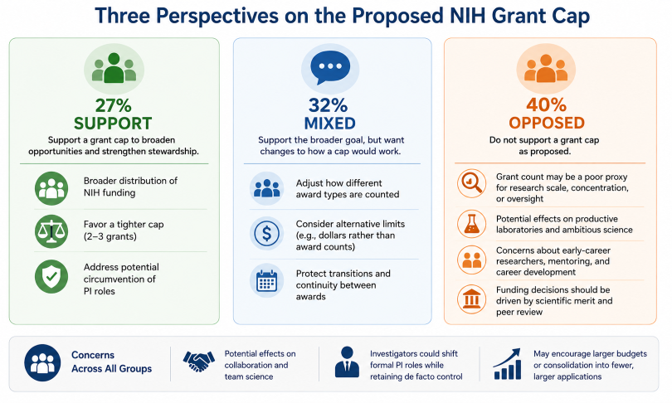
About 40% of respondents opposed the proposal, 32% expressed mixed views, 27% supported it, and about 1% were neutral.
- Comments were distinctly divided between those who supported and opposed the proposal. These respondents generally emphasized different priorities and concerns, with relatively little overlap in the arguments they offered for or against the approach.
- Respondents with mixed views generally supported the broader objective of distributing NIH funding more widely but questioned the mechanism and structure for a grant cap.
- Those who were neutral raised procedural questions rather than taking a position on the substance of the proposal.
Preferences about the size of a potential cap differed substantially according to respondents' overall views of the proposal (see table below).
| Preferred Approach | Support | Mixed | Oppose |
|---|---|---|---|
| Cap of 2 | 51% | 7% | <1% |
| Cap of 3 | 40% | 32% | 1% |
| Cap of 4 | 5% | 44% | 33% |
| No cap | 0% | 4% | 50% |
Nearly half of respondents attached conditions to their preferred grant limit, including considerations for grant type, career stage, institutional contexts, and timing of transitions between closing and initiating awards (to avoid losing staff or interrupting research).
Respondents who supported the proposal:
- Generally favored a relatively tight cap of 2 or 3 grants
- Frequently emphasized broader distribution of NIH funding
- Were concerned about potential circumvention through reassignment of PI roles
- Felt it could open opportunities for less-established investigators
Respondents who expressed mixed views:
- Often supported the goal of distributing funding more broadly but wanted changes to the proposed mechanism
- Frequently suggested partial counting of multiple-PD/PI awards
- Suggested exemptions for smaller exploratory awards
- Raised alternatives such as limits based on total funding rather than award counts
- Raised issues involving award transitions and continuity
Respondents who opposed the proposal:
- Questioned whether grant count adequately reflects research scale, funding concentration, or investigators' ability to oversee awards
- Raised concerns about effects on productive laboratories and ambitious science
- May lead to established investigators being less willing to include early career colleagues on multiple PD/PI projects or disrupt mentoring and career development for those researchers
- Frequently favored stronger use of existing overlap and budget review mechanisms rather than a new grant-count limit
- Emphasized funding decisions should continue to be driven primarily by scientific merit and peer review, rather than by the number of awards designating a specific principal investigator
- Could create additional tracking, compliance, timing, and enforcement complexities for investigators, institutions, and NIH
Other approaches respondents asked NIH to consider (which are not mutually exclusive):
- Capping dollars rather than grant count (around 750 responses)
- Partially counting multiple investigator grants (around 700 responses)
- Enforcing existing overlap review policies and processes (around 700 responses)
- Exempting small grants such as R03 or R21 (around 670 responses)
- Requiring minimum PI effort per grant (around 400 responses)
- Capping total funding per lab (around 250 responses)
Several points cut across respondent groups, whether they are in favor of a cap or not:
- Concerns about potential effects on collaboration and team science, especially if investigators are reluctant to participate on multiple PI applications/awards
- Investigators could shift formal PI roles while retaining de facto control of the work
- Could encourage investigators to seek larger budgets or consolidate work into fewer, larger applications
Where do we go from here?
NIH is carefully considering your comments and recommendations, which will inform next steps. We will share additional information as this process moves forward.