 An official website of the United States government


So, I’m Interested in a Highlighted Topic…What Do I Do Now?
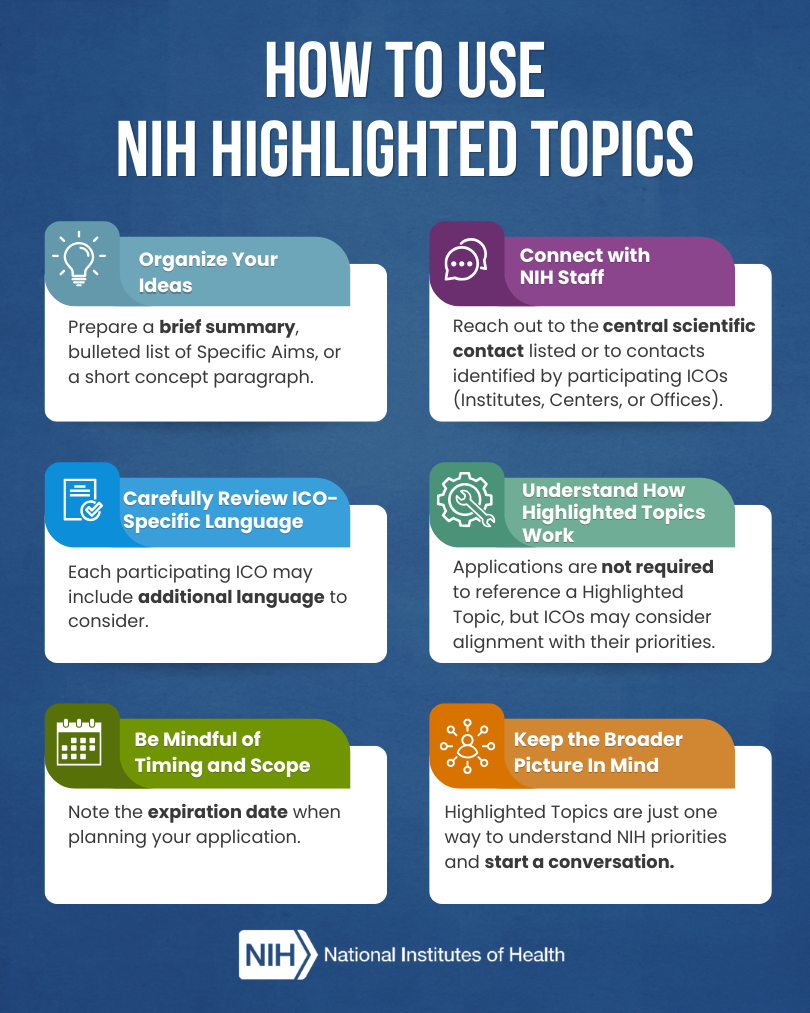
Come across the new Highlighted Topics resource and wondering, what do I do with these? You are in good company, as this is a question we have heard a lot lately.
In short, Highlighted Topics are a way to understand NIH priorities and start a conversation. it is important to note though that NIH Institutes, Centers, and Offices (ICOs) continue to fund a wide range of high-quality research beyond areas identified as a Highlighted Topic.
If you have a research idea that may align with a Highlighted Topic, there are several steps you can consider before preparing and submitting an investigator-initiated application. As a reminder, Highlighted Topics communicate priority area of research for a particular ICO. We encourage you subscribe to receive weekly alerts, so you don’t miss when new topics are posted.
Start with organizing your thoughts
It may be helpful to prepare a brief summary, bulleted list of Specific Aims, or a short concept paragraph when you see a Highlighted Topic of interest. Organizing your thoughts in advance will help facilitate discussion with NIH staff next.
When preparing your ideas, focus on scientific concepts that align with your expertise. You should not significantly reshape your project just to match a Highlighted Topic if it doesn’t reflect your genuine research interests.
Connect with NIH staff.
Reach out to the central scientific contact listed in the Highlighted Topic (found after the main description) or to contacts identified by participating ICOs. These program staff are subject matter experts who can:
- Help you understand how the topic aligns with their ICO’s mission and research priorities
- Assess the fit of your research idea, but keep in mind your idea does not need to match every aspect of a Highlighted Topic to be relevant.
- Suggest appropriate funding opportunities to consider
When identifying the appropriate parent announcement or other broad opportunity, you might consider factors like:
- The size of the project: e.g. R21 for Smaller exploratory studies or R01 for Larger more comprehensive projects
- Need for international collaborations: e.g. new PF5 (see these articles from March 2026 and September 2025 for more)
- Career stage: e.g. career development (K) or fellowship (F) opportunities
It is important to remember that you do not apply to a Highlighted Topic. These are meant to communicate areas of scientific priority and are neither a funding opportunity nor found on Grants.gov.
Learn more about an ICOs research areas of interest
You can explore an ICO’s mission and programs through its ICO profile page, including seeing their relevant Highlighted Topics. Moreover, ICOs may have additional explanatory language describing how the Highlighted Topic fits within its research focus areas. Reviewing this information can provide insight into the types of research the ICO aims to support.
Understand how Highlighted Topics relate to funding decisions.
Applications are not required to reference a Highlighted Topic. Mentioning a topic in your Specific Aims, Significance, or other section is at your discretion.
Keep in mind though that referencing a topic in your application does not affect receipt, referral, or peer review. Reviewers are not asked to evaluate applications based on their relevance to a Highlighted Topic. In other words, including a Highlighted Topic will neither advantage nor disadvantage your application during the review process.
However, ICOs may consider how well a reviewed application aligns with their stated priorities (such as those expressed in a particular topic) when making their funding decision. They do so consistent with their internal processes and available funds (in alignment with the NIH Unified Funding Strategy), and may also indicate special consideration and/or dedicated funding for the topic itself.
Be mindful of timing and scope.
Highlighted Topics are time-limited and may evolve as scientific priorities change. Be sure to note the expiration date when planning your application.
If a topic expires, you can ask the associated ICO scientific contacts if they are still giving special considerations if that topic is still a priority area, or if funds are still dedicated to the topic.
Keep the broader picture in mind.
Highlighted Topics represent only a subset of an ICO’s interests. In some cases though, ICOs may give additional consideration to meritorious applications that align with these priorities.
There is no single formula for developing an application aligned with a Highlighted Topic.
And finally, if you’re thinking about another research idea or area currently not identified as a Highlighted Topic, these tips may also be helpful to consider there as well.
Additional Resources
- NIH Extramural Nexus: Introducing Highlighted Topics: A Centralized and Simple Resource to Learn About Research Areas of Interest to NIH
- NIH Extramural Nexus: NIH’s Path to a Simpler Funding Opportunity Landscape